The photo. The crew.
The money finds out last.
This roof doesn’t leak. Most books do.
All Roof is the system of record for roofing companies. A job’s money arrives as one number and settles as four — and when those four are allowed to net into each other, a $9,000 check can hide a $6,000 hole.
One record. Five very different days.
The owner and the crew are not looking at the same problem, and software that pretends otherwise ends up written for whoever signs. Open the one that is yours.
The repYou have been paid off an approved number and watched it come back. Nobody could show you where it went.
You knock, you sell, and you get paid on what actually collects.
The credit follows the address, not whoever types it in
A door you worked is a door you worked. Pins, territories and 7 knock outcomes on a map that already knows the storm — so the record of who was actually standing there is the record, and it is not up for renegotiation later.
Your pipeline, without asking the office
Every job you sold, what stage it is actually in, and how long it has been sitting there — visible to you, on your own file, without asking. You stop finding out what happened to your deal from someone who is busy and half-remembering.
Why the money is where it is
Recoverable depreciation is not late — it is not askable yet, not until the certificate of completion is signed. When a file shows short, the record says which bucket is holding it and what has to happen next.
The follow-up list builds itself. It never sends itself.
Snooze ninety days, mark it lost, set it to revive — 12 outcomes, each one writing the stage, the follow-up and the suppression in a single transaction. The list is waiting for you. Nothing goes out without you.
You are not the one who signs for this. You are usually the one who finds out first.
Show it to whoever doesThe officeRight now the load-bearing memory in the building is you, and everyone knows it — including whoever fears your two-week vacation.
You are the one who finds out.
Nobody's memory is load-bearing
One feed per job. Every call, note, document, stage move and payment on the same file, in order, with a name and a time against it. The week you are out, the file still knows.
What is blocking Monday, by name
No crew assigned, certificate expired, material not ordered, deposit not collected. It tells you what is missing before you advance a job — a checklist that names consequences, not a server-side lock.
Checks stop being a mystery
Typed check entry, custody recorded at the moment of entry, and an append-only ledger in integer cents. An overpaid check on one bucket never quietly covers an open balance on another, so the collections list stays true.
The certificate is not paperwork
It is the gate on real money. The record knows which files are waiting on one, which is the difference between chasing a signature and chasing a payment.

Thirty minutes. Bring one week of files and we will walk them with you.
Book the thirty minutesThe ownerA season can gross fine and collect badly, and the books will balance the whole way down.
You sign the checks and you carry the risk.
One balance cannot keep four promises
A storm job's money is four separate obligations. Held apart from entry onward, in integer cents, so a total that looks right cannot hide a hole underneath it.
Money at risk, painted instantly
Deductibles uncollected, approved supplements unpaid, depreciation released and unbilled. The lane is built from your own records — no AI call, so it paints instantly.
The record cannot be quietly rewritten
An append-only event spine behind the ledger. What changed, when, and who changed it — the same question an accountant, a lawyer, or a buyer of your company will ask.

Bring the season that grossed fine and collected badly. We will split one month of it on screen.
Book a demoThe crewThe build sheet lives in someone's truck, and the punch list arrives as a phone call three days later.
You are on the roof, and the office is not.
The build sheet, on the roof
5 roof systems, each with its own checklist — 56 items in total, and 71% of them will not close without a photo. The proof is captured where the work happens.
A work order that prints
Because the roof does not have wifi, and a phone in a pocket is not a plan a crew can work from.
What you touch is what you can change
Crew access is narrowed to the job in front of you and the fields that belong to it. Not a policy in a handbook — a fence in the database.
Material that reconciles
What was ordered against what was actually used, recorded on the job rather than remembered at the end of the week.
Ask to see the build sheet on a phone, in daylight, with gloves on.
Show it to whoever signsCommercial & serviceA leak call comes in at 7:40 and the answer is already in your own files — but nobody can find it before the truck rolls.
Your customer is a property manager, and your book is recurring.
Buildings, not addresses
An account holds properties, a property holds roof sections, and a section carries its own membrane, age, warranty reference and condition grade. Repeat history attaches to the section, not to a job number.
The document your client takes upstairs
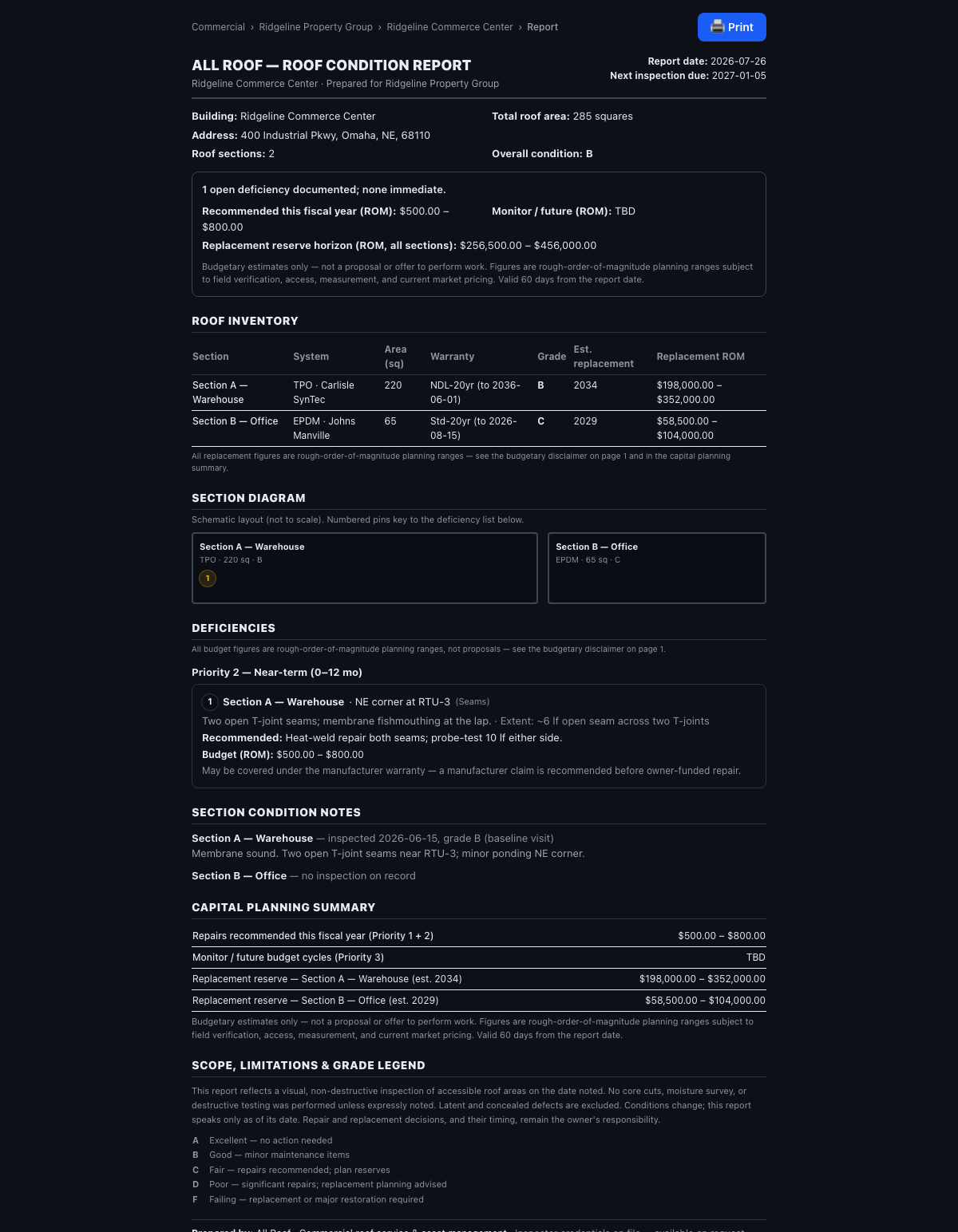
A building's roof as an asset on a schedule: what is up there, what condition it is in, and what it will cost to deal with — in ranges honest enough to survive a budget meeting.
Agreements that know their own terms
Service agreements with term, auto-renew, escalator, not-to-exceed and response window — with billing periods that must sum to the contract amount before they can be saved.
A portal you decide what goes into
Property managers see what you publish and nothing else. Every walk starts unpublished, on purpose.
Thirty minutes. Bring one building and we will build its roof asset record on screen.
Book a demoRain finds the gap. So does money.
Water follows the one seam you missed. Storm money does the same — through the gap between four obligations and the one balance holding them. Here is where it actually goes.
A storm job looks like a single figure on a single line.
It never was one. It's four separate obligations, and only two parties are on the hook.
Recoverable depreciation isn't late. It isn't askable yet — not until the certificate of completion is signed.
The carrier nets once, when it works out the ACV figure. After that the four stand apart: an overpaid ACV check does not quietly cover the deductible. Different payers, different obligations — so the collections list stays true.
A $9,000 check can hide a $6,000 hole. This math is why it can’t here.
That was a real case — mis-keyed against $3,000 owed, the file read collected while $6,000 sat uncollected. The same algebra runs below, in your browser. Open The overpaid check: the carrier’s money came in $2,000 heavy, and watch the deductible sit there open while the file reads settled. And if all four bottom lines match your books, you didn’t need this page.
ACV check deposited, deductible collected, supplement approved. Depreciation is real money you cannot ask for yet.
Outstanding on buckets with nothing standing in the way.
Real money. Just not askable until the certificate of completion is signed.
| Bucket | Owed | Received | Open | Actions |
|---|---|---|---|---|
| Carrier ACV | $18,344 | $18,344 | clear | |
| Homeowner deductible | $1,000 | $1,000 | clear | |
| Recoverable depreciationHeld until the certificate of completion is signed | $6,149 | — | $6,149 | |
| Approved supplement — cash now | $2,457 | — | $2,457 |
All Roof is software for roofing contractors. It is not an insurance adjuster, insurance producer, or public adjuster, and it does not provide insurance, legal, or claims advice. All Roof does not negotiate, adjust, or settle insurance claims. Coverage determinations and claim payments are made solely by the insurance carrier under the terms of the policyholder's policy. Contractors are responsible for complying with the licensing and insurance laws of the states in which they operate.
Same refusal. Different payer.
A storm job’s four obligations are not allowed to cover for each other. Neither are a service account’s. Pick a month and watch what a system that nets would have told you instead.
Four invoices, one payer, and only one of them actually settled.
- Collected$22,000.00cash applied to an invoice
- Credited$0.00reduces what is owed, and is not cash
- Written off$0.00closes the remainder
- Open AR$6,490.00what is still collectible
Partition closes — $28,490.00 = $28,490.00
- Unbilled backlog
- $54,000.00
- Cash on account
- $3,100.00
- Over-collected
- $0.00
Held outside the partition on purpose. None of these is ever summed into an AR figure, and none of them nets against an open balance.
open, instead of $6,490.00. Two different things get buried by that one figure: $3,100.00 of receivables made to look collected, and $3,100.00 of cash you are holding that isn’t yours — a deposit owed back, or work owed for it.
The $3,100 on account is real money and it is not a receivable — it is a deposit you owe back or owe work for. Net it into AR and your open balance quietly under-reads by exactly that much.
The model is the product’s own commercial partition, in integer cents. The customers are a fictional demo book.
Shipped, deployed, and photographed
Real captures from the running application — not mockups.
The document your client takes to their asset committee
Roof inventory with replacement horizons, a numbered-pin section diagram, priority-grouped deficiencies with recommendations, a capital-planning summary, and a limitations appendix. Budgetary ranges, never a false-precision dollar. This is the whole commercial pitch in one artifact.
Captured from the running application. The jobs and figures are a demo book of fictional customers — not results from a real one.
You're going to run your money through this.
Four figures, each reproducible against the deployed tag. We'd rather hand a technical buyer specifics they can check than an adjective they can't.
across 278 files, in the shipped release
across 50 tables — isolation lives in the database
run against a live two-organization database
integer cents from the entry onward
Thirty minutes, your numbers on screen.
No deck. The calculator above ran on our numbers; the demo runs on yours. Bring the one job where the total looked right but the file never felt finished, and watch it split into four buckets on screen.
Is it actually built?
V1.66 is deployed — 44 pages, 61 database migrations, 4,061 passing tests. The calculator above is the real money model, running in your browser.
How many companies use it?
Few, and we won't inflate that. There's an active commercial pilot and a trial tenant. If you need to be customer two hundred, we're the wrong call today. If you'd rather shape it, that's the window.